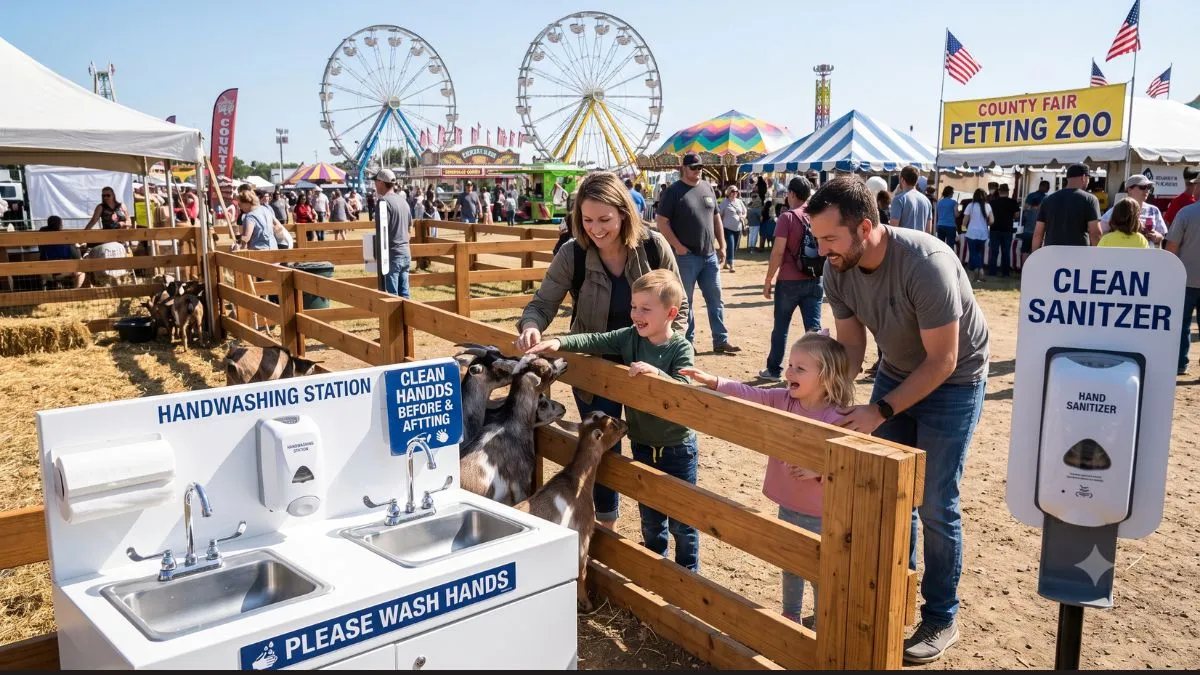
U.S. public health and agricultural agencies expanded regulatory oversight and sanitation warnings across mobile and stationary petting zoos this week following repeated exposures to zoonotic pathogens, including rabies and Shiga toxin-producing Escherichia coli.
Federal directives from the Centers for Disease Control and Prevention (CDC) and the U.S. Department of Agriculture (USDA) urge venue operators, county fair boards, and local health departments to enforce stricter barrier protocols between patrons and exhibited livestock. The action follows late-summer investigations across multiple states where visitors—predominantly children under five—contracted bacterial enteric infections or required post-exposure prophylaxis after direct contact with infected calves, sheep, and young goats.
State health authorities recently confirmed rabies exposures linked to mobile petting exhibits in North Carolina, where four juvenile goats contracted the viral disease following exposure to wild vectors. Because young livestock often enter public interaction spaces before reaching the minimum age required for standard veterinary vaccination schedules, public health officials ordered contact-tracing measures across multiple counties. Simultaneously, public health epidemiologists in Rhode Island and Arizona monitored separate clusters of Cryptosporidium and E. coli infections tied to fairground livestock enclosures.
| Risk Category | Common Pathogen / Agent | Primary Transmission Route | Recommended Mitigation Protocol |
| Bacterial | E. coli O157:H7, Salmonella | Direct contact, touching contaminated fencing or bedding | Mandated perimeter handwashing stations with running water and soap |
| Parasitic | Cryptosporidium, Giardia | Ingestion of microscopic fecal matter from animal fleece/fur | Strict ban on pacifiers, strollers, open food, and drinks in enclosures |
| Viral | Rabies virus | Saliva transfer via bites, nips, or contact with broken skin | Proof of veterinary clearance, physical distance barriers, age floors |
Under the refreshed guidance, the CDC advises commercial agricultural exhibitors to separate eating zones entirely from animal contact areas and install double-gated, supervised handwashing sinks. Running water and soap remain the baseline requirement, as alcohol-based sanitizers fail to eradicate certain spore-forming organisms like Cryptosporidium. Facility operators must also post clear warning notices advising parents that infants, elderly visitors, and immunocompromised individuals face higher risks of hemolytic uremic syndrome (HUS) and systemic illness from common livestock bacteria.
County agricultural commissions are adding physical inspection requirements ahead of fall festivals. Inspectors now assess exhibit perimeters for wildlife barriers, clean manure removal schedules, and crowd density controls to prevent overcrowding within animal pens. Veterinarians note that animals shedding harmful pathogens frequently appear healthy and show no active symptoms, requiring preventative structural standards rather than visual inspection alone. Federal regulators continue monitoring county fair data to determine whether standardized, mandatory licensing rules will replace voluntary state-level guidelines before next year’s agricultural fair season.
No questions yet. Be the first to ask!