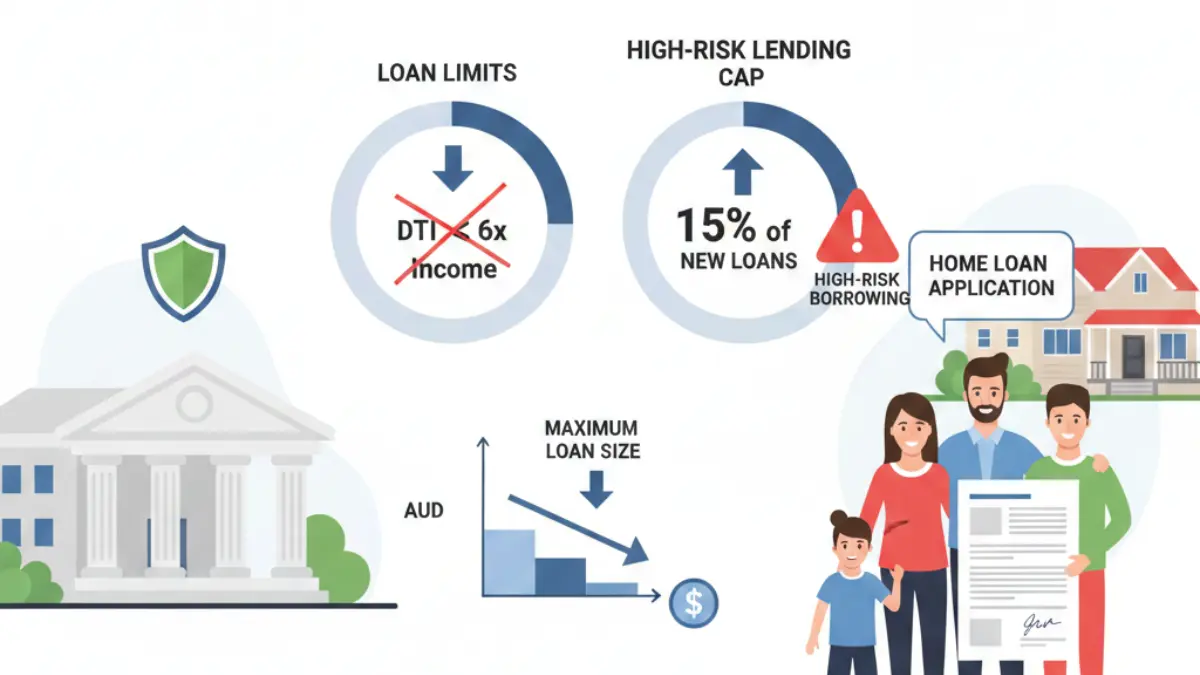
In a major move aimed at cooling down borrowing risks and safeguarding the housing market, the Australian banking regulator APRA has announced its first-ever limit on high debt-to-income (DTI) home loans. Starting February 1, 2026, banks will be restricted such that no more than 20% of new mortgages can be granted to borrowers whose debt is six times (or more) their annual income. Reuters+2The Australian+2
Why APRA is Acting — The Bigger Picture
Over recent quarters, Australia has witnessed a surge in borrowing: investor loans jumped by 18% in the September quarter alone, driving housing credit growth beyond long-term averages. Reuters+2The Guardian+2
Such spikes in highly leveraged lending — where borrowers take on large mortgages relative to their incomes — pose systemic risks. If economic conditions deteriorate, or if interest rates rise, borrowers may struggle with repayments, potentially triggering defaults. Given that the banking system in Australia is heavily exposed to residential mortgages, these risks could ripple through the financial system. Reuters+1
APRA’s chair described the move as pre-emptive — “introducing limits or guard rails now will help mitigate risks stemming from high-risk lending and be less disruptive than waiting.” Reuters
What the New Rule Actually Does
- From February 2026, banks must ensure that no more than 20% of their new home loans exceed a DTI ratio of 6:1 (i.e. debt 6 times annual income or more). The cap applies to both owner-occupiers and investors. Reuters+2The Australian+2
- Loans for new housing (i.e. brand-new dwellings) are excluded from this cap. Reuters+1
- As of now, only around 4% of new owner-occupier loans and 10% of investor loans exceed the 6x-income threshold. That suggests the 20% cap offers a buffer, preventing a sudden shock to borrowers who exceed the benchmark. Reuters+1
What It Means for Borrowers and Investors
For most homebuyers — especially those taking conservative or moderate loans — the new rule is unlikely to directly affect them, because their DTI will naturally fall below 6x. However, for risk-tolerant investors or buyers stretching their incomes to the limit, this rule will be a clear constraint.
Some likely outcomes:
- Borrowers may need to look for smaller mortgages or larger down payments to stay within DTI limits.
- Investors may see reduced access to highly leveraged loans, curtailing speculative property buying.
- Some potential borrowers might turn to non-bank lenders or alternative financing, if banks become stricter.
- Overall, this could help cool the tail end of high-risk home lending, reducing chances of future mortgage defaults and stabilising the housing sector.
Not a “Price-Cooling” Move — But a Stability Guardrail
Several analysts have made it clear: this is not a blunt instrument to bring down home prices or crimp borrowing broadly. Rather, APRA calls it a “guardrail.” The Guardian+1
By only capping the highest-leverage segment — loans with DTI 6x or more — APRA leaves room for moderate borrowers, first-home buyers, and those taking conservative loans. The aim is financial system stability, not market intervention. The Australian+2The Guardian+2
That said, some housing-market observers say the 20% cap may be too lenient for a market already facing sharp investor-driven growth; they argue stronger measures may be needed down the road. The Guardian
Understanding Debt-to-Income (DTI) Ratio — Why It Matters
Before diving into common reader questions, it helps to clarify what DTI means and why lenders — not just in Australia — watch it carefully.
- The debt-to-income ratio measures how much of a person’s income goes toward debt repayments (EMIs, other loans, credit card bills, etc.). Tata Capital+1
- A lower DTI signals that borrowers have enough income cushion after debt payments — making it more likely they can repay future loans. A high DTI, however, indicates risk: even slight interest rises or income shocks might lead to defaults.
- Many experts suggest a “safe range” of about 40–50% of monthly income going toward total debt payments (including the new home loan) for sustainable borrowing. https://asbl.in+1
While these guidelines come from general lending practices (including in India and elsewhere), the key insight remains — even if credit scores are good, over-leveraging via high DTI can be risky.
What This Means for India (and Borrowers like You)
You might wonder: “What does a change in Australia matter if I’m in India?” The answer: almost everything.
- The new APRA rule puts spotlight on the idea that regulators globally are increasingly wary of high-leverage home loans.
- Further, even though the Indian Reserve Bank of India (RBI) doesn’t currently use a DTI-based cap like APRA’s, Indian borrowers are judged based on other metrics such as credit history (CIBIL), Loan-to-Value ratio (LTV), income documentation, etc. Magicbricks+2Reserve Bank of India+2
- For borrowers in India, this is a reminder: instead of just chasing big loans, it’s wise to check whether your monthly EMI burden leaves enough breathing room — especially if you have other debts or unstable income.
- Home loan seekers should keep an eye on global regulatory trends: if regulators elsewhere impose such limits, Indian regulators may — eventually — consider similar prudential norms, especially if household debt rises substantially.
50 “People Also Ask” — With Simple Answers
Below are fifty common questions readers may have, along with short, straightforward answers.
- What is a debt-to-income (DTI) ratio?
The DTI ratio is the share of your income used to make debt payments — including home loan EMIs, other loans, credit card bills, etc. Tata Capital+1 - Why does DTI matter for home loans?
It helps lenders assess whether you can realistically afford repayments without stretching your finances. - What is the new DTI limit set by APRA?
No more than 20% of new mortgages can go to borrowers with debt equal to or greater than six times their annual income. Reuters+1 - When does the rule come into effect?
February 1, 2026. Reuters+1 - Does the cap apply to both investors and regular homeowners?
Yes — both owner-occupiers and investors. Reuters+1 - Are all home loans affected?
No — loans for new housing dwellings are excluded from the cap. Reuters+1 - What percentage of current loans exceed the 6x DTI threshold?
Roughly 10% of investor loans and 4% of owner-occupier loans currently exceed that ratio. Reuters+1 - Will this rule reduce home prices?
Not directly. The cap is a stability measure, not a price-control tool. The Guardian+1 - Why is APRA doing this now?
Because investor lending surged, and there are signs of rising risk in highly leveraged mortgages. Reuters+2The Guardian+2 - What happens if a bank issues more than 20% restricted loans?
That would breach the regulation — banks must comply or face regulatory consequences. - Will this affect first-home buyers with moderate incomes?
Probably not, if their loan amount keeps their DTI under 6x. - Could banks still lend at high leverage via non-bank lenders?
Possibly — some borrowers may explore alternate lenders if banks restrict. - Does this rule affect existing loans?
No — only new home loans issued from Feb 2026 onward. - Will interest rates change because of this rule?
Not necessarily; the rule limits loan volume, not interest rates. - What is a “safe” DTI ratio?
Many experts suggest 40–50% of monthly income toward total debt. https://asbl.in+1 - How is DTI calculated?
Add up all monthly debt payments (EMIs, etc.), then divide by monthly income. - Is there a similar DTI rule in India?
Not currently — Indian lenders mostly use credit score, income docs, LTV ratio and overall profile. Magicbricks+2mortgagerio.in+2 - What is LTV ratio and how is it different from DTI?
Loan-to-Value (LTV) ratio compares loan amount to property value; DTI compares debt to income. Reserve Bank of India+1 - Why do regulators care about DTI?
Because high DTI means borrowers may struggle if rates rise or income drops — a risk to both borrowers and banks. - Could this cap slow down the real estate boom?
Maybe the very high-leverage segment will shrink, but moderate borrowing should continue. - Does this affect only mortgages or other loans too?
The cap applies specifically to new home loans (mortgages). - What kinds of loans are excluded?
Loans for new housing dwellings are excluded. Reuters+1 - Is the cap permanent?
The regulation doesn’t specify an end date; it’s a prudential norm. - Can banks adjust this cap internally (e.g. 10%)?
They could, but must not issue more than 20% loans over the 6x threshold — lower internal thresholds are possible. - Will this impact rental property investors more?
Yes — since many investor-mortgages tend to have high leverage. - Could this push borrowers toward non-bank lenders or private finance?
It’s possible, especially for those needing high leverage. - Does this mean investors will stop buying properties?
Not necessarily — but they may opt for lower leverage or larger down payments. - What if someone’s income is irregular (part-time, gig)?
Banks may be more conservative, making high-DTI loans harder to get. - Does debt include other loans apart from home loans?
Yes — DTI calculations consider all outstanding debts and liabilities. - How does this affect loan EMI affordability?
It encourages borrowers to take loans they can comfortably repay, reducing future stress. - Will existing bank customers be forced to prepay or restructure?
No — the cap applies only to new loans. - Is this kind of rule common globally?
Some countries already use DTI or loan-to-income caps; this is Australia’s first formal DTI cap. - What if a borrower’s income increases later?
That might allow them to refinance, but that depends on lender policies. - Could this rule lead to fewer housing units sold?
Possibly fewer high-leverage purchases, but demand from regular buyers may remain stable. - Does this protect homebuyers or banks more?
Both — it reduces risk of borrower over-leveraging and protects banks from widespread defaults. - What if a borrower has savings or other assets — does that help get around the rule?
Possibly lenders may consider assets or collateral, but the DTI cap remains a key check. - Will this affect interest-only loans or adjustable-rate loans differently?
The rule doesn’t specify loan type — any mortgage counts if DTI is high. - Could this make it harder for young first-home buyers?
If they rely on high leverage, yes — but loans within reasonable DTI should still be fine. - Does this mean banks will offer smaller loan amounts?
For high-income borrowers with big loan needs, yes — they may require larger down payments. - Is this more helpful for housing stability or for market cooling?
More for stability — preventing risky borrowing that could lead to defaults. - What happens if housing prices keep rising even with this rule?
The rule doesn’t control prices — but it can reduce debt-fueled speculation, possibly tempering runaway demand. - Will this affect rental yields or property returns for investors?
Potentially — if investors pay more equity and borrow less, returns on leverage may shrink. - Could banks reject more loan applications because income doesn’t support DTI?
Yes — stricter screening likely for high-debt borrowers. - Will banks tighten lending norms beyond DTI limits?
Possibly — if risks rise, regulators may impose further restrictions, e.g. investor-specific caps. The Guardian+1 - Is this rule retroactive for loans sanctioned before 2026?
No — it applies only to new loans after February 1, 2026. - Could this make home loans more expensive or harder to get?
It might make high-leverage loans harder to obtain, but regular loans should remain accessible. - Does this impact interest rates or just loan eligibility?
Just loan eligibility — interest rates are driven by broader market conditions. - Are banks likely to offer alternative financing to bypass this rule?
Some non-bank lenders or private financing may see demand, but they tend to be costlier and riskier. - Is there a risk banks will avoid issuing many loans and reduce supply?
Unlikely — only a portion (those with high DTI) are affected; banks still have plenty of scope to lend responsibly. - What should a borrower do if they are eyeing a home loan now?
They should calculate total debt, including existing obligations, and ensure their DTI remains comfortably below 6x (or whatever their local lender’s threshold may be) before applying.
Final Thoughts — A Wake-Up Call for Global Borrowers
The new DTI cap from APRA is a clear signal: high leverage can jeopardize not just individual borrowers — but entire financial systems.
For ordinary homebuyers, the message is simple: borrow responsibly. Choose a loan that fits comfortably with your income, not just one that stretches your income to the edge. For investors and speculators — this might be a wake-up call to balance ambition with caution.
For people in countries like India, even though lenders don’t (yet) use DTI-based hard caps, the APRA decision serves as an important reminder: the safety of your home loan depends not just on the interest rate or the price of the home — but on how much debt you are carrying relative to what you earn.
If you like, I can also project how a similar DTI-cap rule might affect Indian home-buyers and real estate markets (given Indian income levels, loan norms, etc.).